Skip to content
Pratiush Sharma
Menu
Yoga philosophy, practised in a modern week

Ancient yoga, for a modern mind.

Two thousand years ago yoga was built to train attention, steadiness and letting go. Those are exactly the skills a phone, a deadline and a short night take from you. I teach the philosophy plainly, and the practices that make it stick: breath, strength, flexibility, and yes, the handstand.

  • 8 weeksfree sūtra course
  • RYT 500certified
  • Since 2011teaching
Pratiush Sharma seated in meditation on a tree-lined avenue, one hand on the heart, one on the belly
YOGA SŪTRA 1.2
“Yogaś citta-vṛtti-nirodhaḥ.” Yoga is the settling of the mind's turnings.

The definition. Everything on this site serves it.

What yoga was built for

Not a workout. A training method for the mind.

The postures came late. The original work was attention, steadiness and non-attachment, trained daily until they became character. Here is how the old words map onto a modern day.

“Abhyāsa-vairāgyābhyāṁ tan-nirodhaḥ.”

Yoga Sūtra 1.12

Steady practice, and letting go of the result. That is the whole method, and it is the opposite of how most of us live: sporadic effort, obsessive attachment to outcomes. Every program on this site is built as a short daily practice with a result you are asked not to chase. The handstand is simply the most honest teacher of it.

Dhāraṇā · attention

Hold one thing

Dhāraṇā is placing the mind on one point and keeping it there. The modern mind is pulled forty times an hour. Training single attention is the first and most practical skill yoga offers.

Practised in: breath counting, drishti, balance drills.

Sthira-sukham · steadiness and ease

Stay, comfortably

Sūtra 2.46 asks for a posture that is steady and easy. Not forced, not slack. The same quality you want in a hard conversation or a long week.

Practised in: long holds, flexibility work, seated stillness.

Vairāgya · non-attachment

Let go

Care about the work, release the outcome. It is the hardest teaching and the most freeing. You cannot white-knuckle a handstand or a life.

Practised in: falling drills, breath retention, rest days kept.

Free reading

Read the guides, free.

Short reading guides on philosophy, breath and practice. Read any of them here in the browser; leave your email once and they are all open to you.

11 pages · philosophy

The Architecture of a Calm Mind

Ancient Eastern philosophy translated through the lens of modern neuroscience: what the old texts say about the mind, what the brain research confirms, and how to use both on an ordinary day.

Free to readRead →

15 pages · focus

The Focus Fortress

The architecture of unshakeable focus. Ancient yogic philosophy meets modern neuroscience in a survival manual for the modern builder: attention as a trainable skill, step by step.

Free to readRead →

12 pages · sattva

The Sensory Diet

Decoding the sattvic mind: what you let in through the senses shapes the mind you live in. How to choose inputs, food and company that leave the mind clear.

Free to readRead →

Learn the philosophy

Start with the ideas. Free.

No sign-up wall for the thinking part. A short course by email, a quiz to test what you know, and the talks on YouTube.

Free email course

Eight sūtras, eight weeks

One sūtra a week. The Sanskrit, a plain translation, what it meant then, what it means on a Tuesday now, and one five-minute practice to try before the next email.

  1. Week 1What yoga is · 1.2
  2. Week 2Practice & letting go · 1.12
  3. Week 3The five turnings · 1.5
  4. Week 4Steady and easy · 2.46
  5. Week 5The eight limbs · 2.29
  6. Week 6Breath · 2.49
  7. Week 7Attention · 3.1
  8. Week 8Freedom · 4.34

Quiz

🧠 Test your yoga knowledge

Five levels, Seeker to Scholar: the Sūtras, the Gītā, the eight limbs, Hatha, the people who carried yoga west. Pass a level to unlock the next, learn one thing per answer, challenge a friend.

Sample: Who compiled the Yoga Sūtras?PatañjaliKrishnamacharyaVyāsaŚaṅkara

5 levels · 75 questionsNo sign-upNever the same question twice

Start the quiz →

Talks & classes

On YouTube

Philosophy talks, breath sessions and full classes on the @yogalifetravel channel. The first class should always be free.

New video weeklyTalks · classes · tutorials

Watch on YouTube

On YouTube

Watch, then practise.

Talks and full-length practices on the mind, the nervous system and the old texts, from the @yogalifetravel channel. The most watched first.

Power Of Semen Retention I 60 Days Effect on Brain

10 Feb 2026

Restart Life From 0 I Sage Patanjali 5 Laws & Neuroscience

21 Mar 2026

How To Get Your Attention Back (5 Steps Before You Loose Everything) I Yoga & NeuroScience

20 Feb 2026

Meet your teacher

About Pratiush Sharma

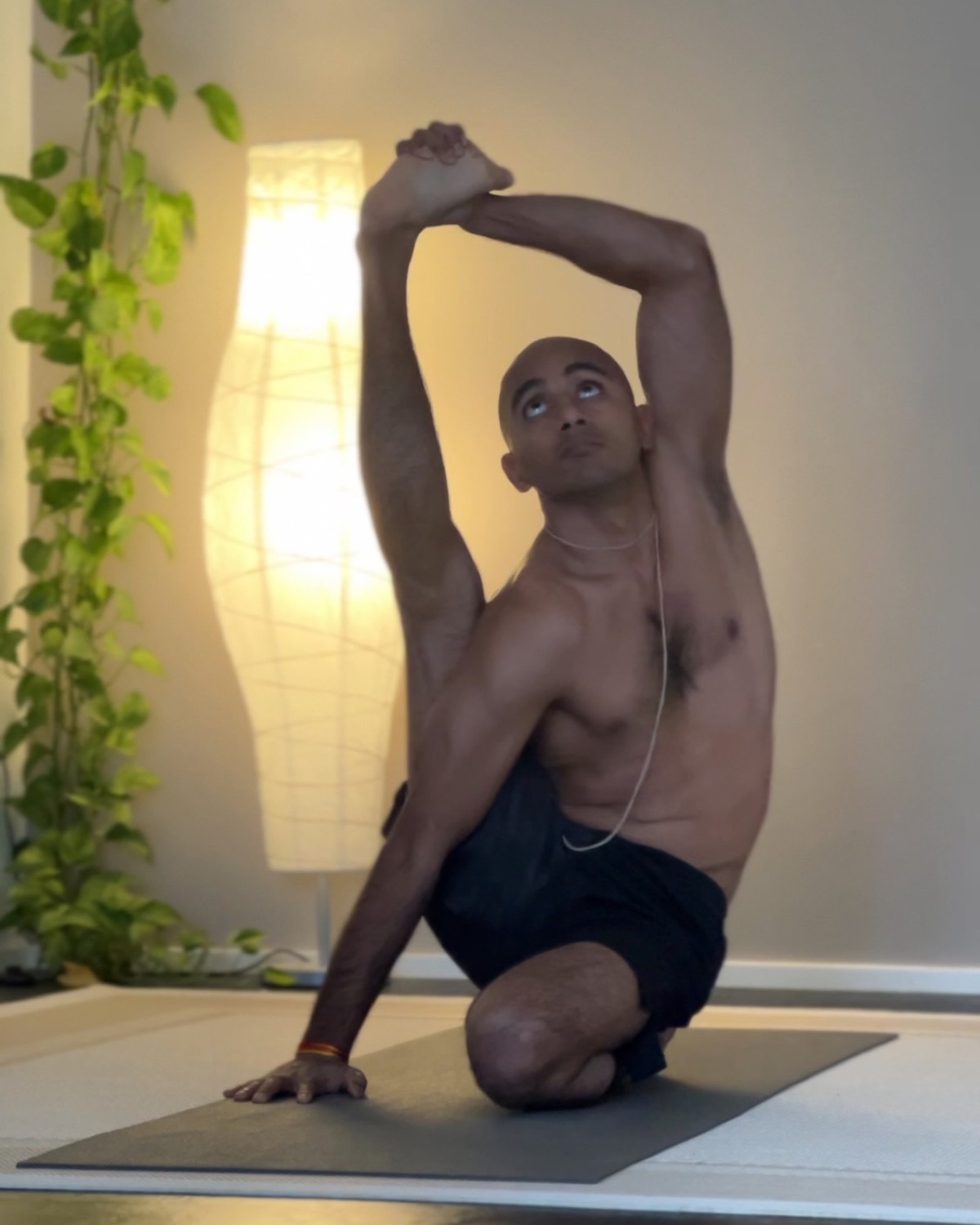
Pratiush Sharma in a seated spinal twist with one leg raised, warm lamp light

I grew up with yoga as philosophy before I knew it as exercise. Later came Hatha and shatkarma in India, then martial arts, calisthenics and Ayurveda. The handstand taught me more about the Sūtras than any seated hour: where the mind goes, the body follows, and what you cannot let go of, you cannot hold.

I teach the old ideas in plain language, and the practices that make them real in a working week. Online because that is where most of you are, on YouTube because the first class should be free.

  • Hatha Yoga, Pranayama, Patanjali Yoga Sutras
  • Teaching since 2011 in India and Germany
  • Yoga philosophy, Asana, Life Vision
  • Creator of the @yogalifetravel channel

Not sure?

Frequently asked questions

Do I need to be religious or spiritual for the philosophy?

No. The Yoga Sūtras are a manual for the mind, not a creed. I teach them the way you would teach a method: what the text says, what it meant, what it does when you try it. You can hold any belief or none.

I have never done yoga. Where do I start?

With the free sūtra course, and with the reading library if you want more right away. Both ask for ten to twenty minutes a day and no equipment.

Is the sūtra course really free, and what comes after it?

Yes, free and without a card. After week eight you stay on the weekly newsletter unless you unsubscribe, which takes one click. There is no upsell inside the lessons.

Why a handstand, of all things?

Because it is the most honest teacher of attention and letting go. Upside down you cannot pretend to concentrate, and you cannot hold on. A full handstand program is in the making; until then the free guides in the library build the base.

Does anything here cost money?

Not right now. The sūtra course, the guides in the library and the videos are free; the guides ask for your email once. Paid programs and 1:1 coaching come later.

Are the course and the guides available in German?

The site and the sūtra course are in English and German. The guides in the library are in English first; German editions follow.

Train the mind. Start with one sūtra.

Eight weeks of the oldest ideas about attention and letting go, one email at a time, free. The programs are there when you want the body to join in.

Free course, no cardPrograms: lifetime access14-day guarantee